The best thing I ever pulled off a curb was a teak sideboard, mid-70s, three drawers that still slid true. It was 9:40 on the last Saturday in June, two blocks from my old place. It was also the fourth Saturday in a row I'd walked that exact loop and found nothing. That's the part people leave out. Curb hunting isn't luck — it's showing up on the right days often enough that eventually the right day is one of the days you showed up.
So let me save you a few empty Saturdays. Here's the calendar I actually use.
The last three days of the month are the whole game
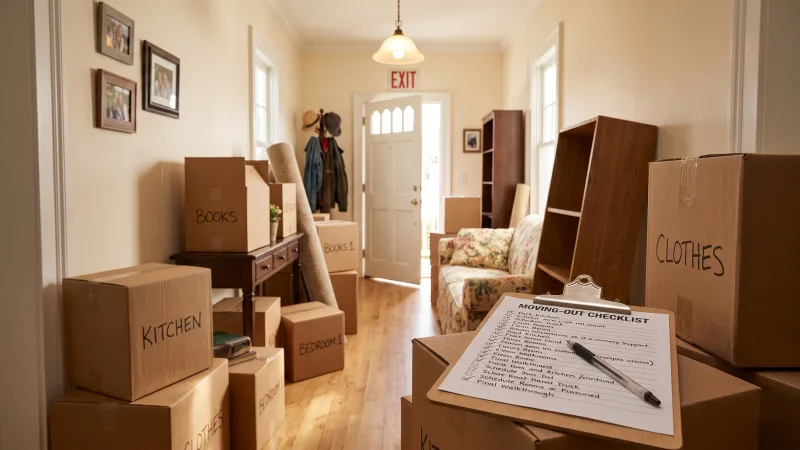
Almost every lease in America starts on the 1st. Which means almost every move-out happens on the 28th, 29th, 30th, 31st. By the time the truck's loaded, somebody's staring at a bookshelf that won't fit and making a decision. That decision is the curb.
The last weekend is peak, but don't sleep on a month that ends midweek — a Tuesday-the-31st move-out puts furniture out on a Monday night when nobody else is looking. My teak sideboard was end-of-June. The two best weeks of my hunting year are the end of June and the end of August, because the monthly cycle stacks with the leases that turn over quarterly. When two waves land on the same weekend, curbs get greedy.
One caveat I learned the hard way: the 1st is not the same as the 31st. On the 1st the movers arriving are unpacking, not shedding. Everything worth grabbing already went out the day before. If you can only walk once a month, walk the 30th, not the 1st.
Follow the students — May, then August, then September 1
If there's a college anywhere near you, its calendar is more reliable than the moon. Finals end in May and a whole senior class abandons an apartment's worth of stuff in about ten days. Then August, when the summer subletters clear out before fall. Desk chairs, floor lamps, those cube shelving units, the occasional futon that's seen things.
Score: an IKEA desk and a barely-scuffed office chair, both on the same May Thursday behind a student building, because a graduating tenant clearly could not fit a life into a Corolla. Miss: I once drove twenty minutes to a dorm move-out and found nothing but broken laundry baskets and a mattress I would not touch with tongs. Dorms skew toward garbage; the apartments a few blocks off campus are where the actual furniture lives.
And if you're in a September 1 city — Boston being the patron saint of this — that date is a genuine local holiday. Allston Christmas is real. Plan your transport a week ahead, go early, and expect competition. Not sure whether your town has a dominant moving day? Watch the curbs around the 1st for a couple of months and you'll see exactly when and where your wave breaks.
Spring purges: where the old solid-wood stuff hides
Moving isn't the only thing that produces curb furniture. The first genuinely warm weekend of the year — call it the one where everyone suddenly has their windows open — kicks off garage-and-basement season. This wave is different. It's homeowners, not renters, which means the finds skew older and heavier: a real oak dresser, a cast-iron patio set, a workbench somebody's dad built in 1988.
My move here is to hit neighborhood yard sales late in the afternoon, around 3 or 4, when sellers are tired and the FREE pile migrates to the curb because nobody wants to haul it back inside. That's how I got a solid-maple nightstand that had a $10 tag on it at 10 a.m. and a "just take it" shrug by 4.
Weekend mornings, and one sneaky Sunday window
Zoom in from the month to the week and the answer is boring but true: Saturday and Sunday, 8 to 11 a.m. That's when people have daylight, energy, and a friend with a truck. Whatever goes out Saturday morning is usually gone by Saturday dinner, so early is the whole thing. A slow loop through a dense renter block before 11 will, over a month, out-produce every clever trick in this article.
The one people miss: Sunday evening. Weekend projects wrap up, the "we are simply not carrying this back to the storage unit" mood sets in, and stuff hits the curb around dusk. Fewer hunters out, too. I've had good Sundays at 7 p.m. that no one else touched until Monday.
The night before trash day is a free extra hunt
Here's the one hardly anyone runs. Every street has a garbage day, and the evening before, people stage their bulky items so they're ready for the morning truck. For that one evening, the whole route turns into an aisle — and everything on it is literally hours from a landfill.
Look up the bulk-pickup schedule for two or three neighborhoods near you (your city's public works page has it), and you've handed yourself several bonus hunting nights a week. Bring a flashlight — evening light lies, and you want to actually see the underside of a cushion before you commit. And read the room: grab what's clearly out for pickup, not the chair someone parked by their door for a minute.
Weather is the asterisk on all of it
Rain is the enemy. One wet night warps particleboard, soaks upholstery, and turns a good find into a science experiment. After a storm, expect a day or two of thin curbs; givers hold their stuff for a dry morning, and you should too. The best hunting stretches are the long clear spells.
Summer produces the most, full stop — moving, yard projects, and daylight all peak from June through September. But summer also means you're the one hauling. I moved a sleeper sofa four blocks at 2 p.m. one July. Once. Now I hunt at 8 a.m. in the heat and let the afternoon people wonder where everything went.
Winter isn't dead, just quieter. Early January brings a small wave as holiday-gift furniture shoves the old stuff out the door, and year-end moves still happen. Bonus: almost nobody's out competing with you in 30-degree drizzle. If you'll brave the cold, January curbs can be weirdly generous.
The real skill is reading your own blocks
Every rule here is a national average, and you don't live in the national average. You live on specific streets with their own tics. So keep a lazy log for a month — a photo on your phone when you spot something out is enough. You'll learn things no guide can tell you: that the six-unit building on the corner turns over on the 15th, that the block behind the hardware store purges every trash eve, that one landlord clears out between tenants on Mondays like clockwork.
These days a lot of givers skip the guessing game and just post the item the second it hits the curb, so it lands on the map instead of waiting for someone to wander by. I do both — I check the app with my coffee, and I still take the end-of-month Saturday walk. The sideboard's in my hallway right now. Some things you have to go out and find.