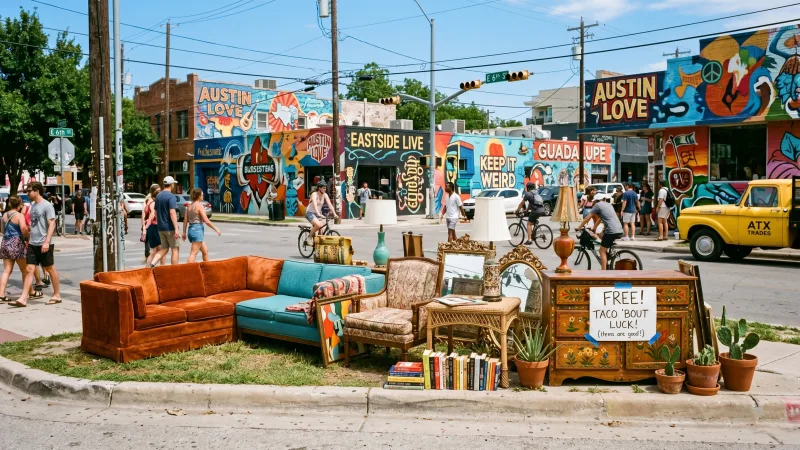
She called it good trash. Not an insult — a genuine category. Something that belonged in neither the garbage nor a store, but in someone else's living room. A dresser with solid bones and bad paint. A lamp that just needed a new shade. She had an eye for it.
The curb economy she participated in was neighborhood-scale and luck-based. What has changed in the last decade is not the impulse — it is the infrastructure.
A Tradition as Old as Suburbia
Long before apps and social media, Americans left items on the curb with a handwritten "FREE" sign taped to them. Neighbors would slow their cars, peek at a lamp or a bookshelf, and toss it in the trunk if it suited them. No money changed hands. No logistics required.
This informal system worked beautifully — but only at a hyper-local level. You could only benefit from your own block, and only if you happened to walk or drive past at the right moment.
What's Changed
Smartphones and GPS have transformed the curb economy. Apps like CurbSofa turn the entire neighborhood into a single, searchable map. A sofa placed outside in Silver Lake at 9am can be seen by someone in Echo Park by 9:01. The effective radius of "your neighborhood" has expanded from one block to several miles — and the speed at which items find new homes has accelerated dramatically.
The Numbers Are Striking
According to the EPA, Americans generate over 12 million tons of furniture waste annually, with the vast majority ending up in landfills. Meanwhile, studies show that the majority of discarded furniture is structurally sound — it's being thrown away not because it's broken, but because its owner is moving, redecorating, or upgrading.
Think about it: A sofa that costs $500 new gets disposed of after 5 years — not because it's broken, but because someone bought a new one. That's a $100/year item going to landfill. The curb economy captures that value and redistributes it.
Community Without Transaction
What makes the curb economy different from marketplaces like Craigslist or Facebook Marketplace isn't just the price — it's the absence of transaction friction. There's no negotiation, no payment processing, no worry about being scammed. You give freely; someone else takes freely. That simplicity creates a different kind of community bond.
CurbSofa is built on this principle. There are no fees, no listings, no "sold" statuses. Everything on the app is free, and it always will be. The only currency is karma — the community recognition you earn for giving.
What Comes Next
The curb economy is growing. As younger generations embrace sustainability and minimalism, the stigma around "used" items has largely disappeared. Finding a beautiful mid-century dresser on a curb in Silver Lake is now something people brag about, not hide.
Technology will continue to accelerate this. Better mapping, smarter notifications, community reputation systems — all of these make the informal curb economy more reliable and more rewarding. CurbSofa is part of that evolution, and we're just getting started.
If you've never participated in the curb economy, there's no better time to start. Put something out this weekend. See what happens. We think you'll be surprised how quickly it finds a new home.