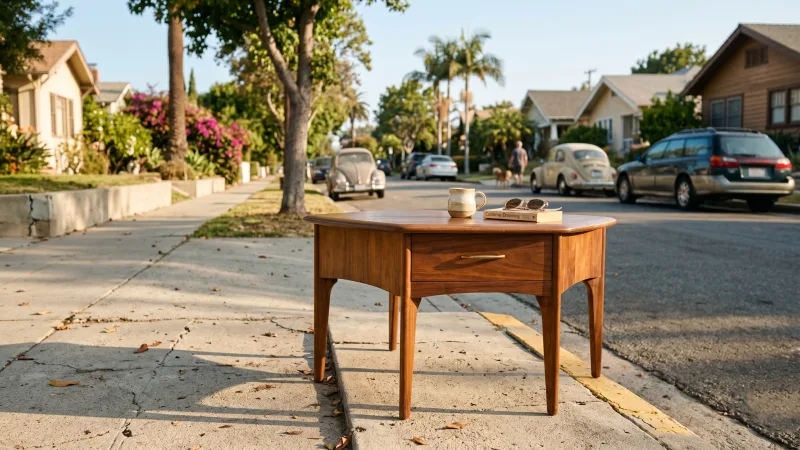
It was a Tuesday in the fall of 2021, and I was walking back from a coffee place on Sunset that no longer exists. Silver Lake, up one of those streets that's basically a staircase pretending to be a hill. And there it was, sitting at the edge of someone's yard like it had every right to be: a walnut table, mid-century, three little scratches on the top and one leg that wobbled if you leaned on it wrong.
No sign. No free scrawled on a paper plate. Just a table, and me, and the specific problem that my apartment was eleven blocks away and I did not own a car that day (long story, mostly involving a friend's move to Portland).
I want to say I paused to consider the environmental implications. I did not. I picked it up, walked it about a block and a half, put it down, sat on the curb next to it to catch my breath, picked it up again. It took me forty minutes. A guy watering his lawn asked if I needed help and then, when I said yes, pretended he hadn't heard me. Fair enough.
That table is next to me right now. Coffee ring and all. I never fixed the wobbly leg — I just know which corner not to lean on, the way you know which stair creaks in your own house.
The thing I couldn't stop thinking about
Here's what actually stuck with me, and it wasn't the table. It was the math I started doing on those walks afterward. Because once you carry one thing home off a curb, you start seeing curbs. It's like learning a new word and then hearing it everywhere.
Within a month I'd clocked a Poäng chair on Hyperion, a full set of unopened moving boxes, a bookshelf that just needed the back panel re-stapled, and a lamp that turned out to work perfectly once I swapped the bulb. All of it left out. All of it gone within a day or two — and I'm fairly sure most of it didn't get carried home by someone lucky. It got carried off by a truck.
LA is a churning city. People land here from Ohio and Texas and everywhere, furnish a place off whatever they can afford, then get priced out or leveled up or a job pulls them to Austin, and the whole apartment goes to the curb in a weekend. There is an enormous, constant river of perfectly good stuff flowing out of this city. The stuff is not the problem. There's plenty of stuff.
The problem is that you have to be standing on the exact right sidewalk at the exact right hour, ideally with a car and a free afternoon, to catch any of it. My table was a coincidence. I hate that it was a coincidence.
It's a visibility problem, and nobody was solving it
So I went looking at the waste numbers, half-expecting to feel better. I did not feel better. Americans throw out something like millions of tons of furniture a year, and the maddening part isn't that it's broken — most of it isn't. A sofa gets tossed because the owner is moving Saturday and the new tenant arrives Sunday and there is simply no time and no easy way to connect it to the person three streets over who's sleeping on an air mattress.
That's not a garbage problem. That's a discovery problem. The giver and the finder never meet. They miss each other by a few hours and a couple of blocks, over and over, all day, across a whole city.
Craigslist and Facebook Marketplace exist, sure. I used them. But the second money enters the picture you get the whole circus: haggling, the person who swears they're "omw" for three hours, the guy who offers you eight dollars for a couch you were literally giving away. Buy Nothing groups get the spirit right, but they live inside Facebook and they're walled off block by block. None of it answers the actual question I had standing on that hill: what free stuff is on a curb near me, right now, before the truck comes?
The one rule I will never bend
When I finally started building what became CurbSofa, I made exactly one decision I refuse to argue about: no money, ever. Nothing for sale. No tips, no "suggested donation," no premium tier where you pay to see the good stuff first.
People tell me this is dumb, business-wise. They might be right. But the moment a dollar changes hands you've built a marketplace, and marketplaces breed the exact friction I was trying to delete — the negotiating, the flaking, the treating your neighbor like a transaction. The idea is stupidly simple: you leave something out, you drop a pin, and whoever gets there first takes it home. Same handshake the curb has always run on. I just wanted it visible across the whole city instead of one lucky block.
So that's what it is. The map shows what's out there. You post what you're leaving, or you go grab something before it's gone. First come, first served. That's the entire mechanic, and I've resisted every temptation to make it fancier.
We started in LA on purpose
We launched here first, and not for sentimental reasons — LA has one of the most relentless curb cultures in the country, so it was the honest place to find out if the thing worked at all. It did. Then it spread the way I hoped: person tells person, one apartment gets furnished off the map and that person posts their old stuff when they move. Other cities followed. It's still spreading, and I still read the posts like a nervous parent.
I won't pretend every pickup is some profound act. Most of the time it's a tired person getting a free desk, and that's completely fine — that's the whole point. But a couch that ends up in a living room instead of a dump is a real thing that really happened, and enough of those add up to something I'm not embarrassed to have spent years on.
Five years later the table's still wobbly and I'm still not fixing it. If you've got something a neighbor could use, put it out and pin it. And if you're the one walking home past a curb, look twice. It changed my whole life once. Slower news weeks, I like to think it still can.