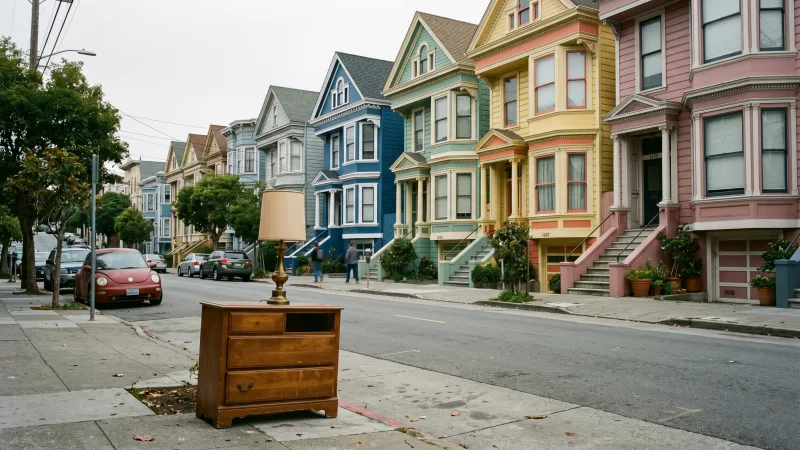
My first spring in Chicago I did what a New Yorker does: I walked the front sidewalks. Up and down Milwaukee, along the tree-lined side streets off Damen, eyes on the parkway strip between the sidewalk and the road. Found nothing but a broken office chair and a bag of somebody's old cables. I figured Chicagoans just didn't put stuff out.
Then a guy loading a bike into a garage saw me looking lost and said, "You're in the wrong place, man. Go around back."
Around back is the whole secret. Chicago is a city of alleys — something like 1,900 miles of them, more than any other city in the country — and every one of them runs behind the buildings where the garages, the garbage carts, and the recycling bins live. That's where people set things when they move out. Nobody drags a couch through a vintage three-flat and out the front door onto a nice residential block. They carry it fifteen feet out the back and lean it against the fence by the dumpster. So if you're hunting the front curbs in Chicago, you are hunting the wrong side of the building.
The alley is the map
Once I started running alleys, everything changed. An alley run is more efficient than a street run anyway — you cover the backs of two full blocks in one straight shot, and the good stuff is grouped near the trash carts instead of scattered. I do it on foot or slow on a bike. In a car you miss half of it and you can't stop.
A few things the alleys taught me. Dumpster-adjacent doesn't mean garbage — people stage the still-good items next to the bin precisely so it doesn't get mistaken for trash, and a solid-wood dresser sitting upright with the drawers closed is somebody being polite about it. Rain is your enemy back there because alleys don't drain great, so upholstery that's been sitting in a puddle overnight is a hard no. And go early. City crews and the scrappers with pickup trucks both work the alleys, and the scrappers are faster than you.
May 1 and October 1: the two days that matter
Chicago runs on two lease dates. May 1 and October 1. Most of the city's apartments turn over on one of those two mornings, which means the days on either side — the last week of April, the last week of September — are when the alleys fill up. This is not subtle. You'll go from empty alleys to an alley with three headboards, a bookshelf, and a perfectly good IKEA MALM in the span of about four days.
May 1 is the bigger of the two. Everybody who signed a summer lease is out, the weather is finally decent, and people have the energy to actually move instead of just shove things down a chute. October 1 is the quieter cousin, but I've come to like it more. Fewer people are paying attention by October, the competition thins out, and the stuff tends to be more considered — folks who moved in May, realized the new place was smaller than they thought, and set the extra table out cleanly rather than in a panic.
Circle those two weeks. If you do nothing else in this whole guide, run alleys the last week of April and the last week of September.
Why spring and fall, and not summer
Winter is dead, and you already know why. Nobody moves a couch in a Chicago January. Wind chill in the single digits, snow packed into gray ridges along the alley, salt on everything — the furniture that does appear has usually been rained and frozen and thawed into something you don't want in your living room. December through February I don't even bother, except to scout: learn which three-flats have the most turnover, note which buildings have property-management signs (coordinated move-out dates), so you've got a head start when it thaws.
Summer sounds like it should be prime, and it's fine, but it fools people. Chicago summers are humid and the storms come out of nowhere — a beautiful 85-degree Saturday turns into a wall of rain off the lake by four in the afternoon, and everything sitting in the alley gets soaked. Upholstered stuff left out on a July night is a gamble. That's why spring and fall are the real windows. Cool, drier, and bracketed by those lease dates. The furniture and the weather cooperate at the same time.
Neighborhood by neighborhood
Where you run depends on what you want, because the neighborhoods sort themselves out pretty cleanly.
Logan Square and Wicker Park are your vintage alleys. These are older housing stock — greystones, vintage two- and three-flats with the original woodwork — and the people leaving them have been accumulating actual character for years. This is where I've pulled solid-wood dressers, a genuinely good mid-century side table, and a cast-iron floor lamp that I'm still using. The alleys off Kedzie and around the Logan Square blue line stop are worth walking slowly. Milwaukee through Wicker Park too. More competition here than anywhere else in the city — you are not the only person who figured this out — so early matters more.
Lakeview and Lincoln Park are a different game. Younger, higher churn, first-real-apartment energy. DePaul is right there, so the turnover is constant and skews toward entry-level furniture in good shape: functional dining sets, bookshelves, desk chairs, the occasional barely-used couch from someone leveling up. The quality is more uniform and less exciting than Logan Square, but the volume is high and the stuff is clean. The alleys around Southport and off Fullerton are reliable. If you're furnishing a first apartment fast and don't need it to have a story, this is your zone.
Pilsen and the University of Chicago area in Hyde Park are both worth adding once you've got the rhythm down — Hyde Park especially in that late-May student exit.
How I actually run it now
Before I leave the house I open the map to see what neighbors have already posted, then I plan a loop through two or three alleys based on what's up rather than wandering. If something good is listed, I go straight for it. If nothing is, I default to a Logan Square alley run and trust the season.
That fence-by-the-dumpster couch I mentioned being suspicious of? I broke my own rule once, in Lincoln Park, first week of October. Somebody had set a small green loveseat out with a piece of cardboard on top that just read "clean, no bugs, please take." It had clearly been sitting under an eave, dry as a bone. I carried it four blocks home on my head like an idiot and it's the best thing in my apartment. Sometimes the note is telling the truth. But check the alley, not the curb — that part's not optional.