Week 0: Two suitcases and a van
I had done a version of this before. When I moved to San Francisco years ago I furnished a whole apartment off the sidewalk, so when the Denver offer landed and the movers quoted me $3,400 to haul my stuff over the Rockies, the math felt obvious. I gave my sofa to a grad student, my bookshelf to a couple in the Mission, my kitchen table to a guy who showed up with a pickup and a dog — all through CurbSofa, all in about nine days. Kept the bed frame because I'm not a monster. Kept the French press for the same reason. Drove a cargo van east and unlocked the door of a second-floor unit off 13th and Downing with echoing empty rooms and one folding camp chair I'd thrown in at the last minute.
Here's the thing nobody tells you: knowing the trick in one city does not mean you know it in another. Denver has its own rhythm, and it took me the full six weeks to stop guessing and start reading it.
Week 1: Just walking
The first week I mostly walked and got skunked. Capitol Hill is dense in a way that should be perfect for this — old brick fourplexes, converted mansions chopped into six units, narrow parking strips crammed with cars. Lots of people, lots of turnover. But I was walking at the wrong times and in the wrong spirit, treating it like a tour instead of a hunt.
My one score was a pair of mismatched dining chairs on a Tuesday morning, wedged against a stoop on Pennsylvania Street with a torn-off cardboard sign that just said FREE in Sharpie. One had a loose seat I fixed with wood glue and two clamps borrowed from a neighbor I'd known for four days. I ate standing at the kitchen counter for another week because I still had no table. But I sat down at night. Small win, and I'll take small wins.
Week 2: The first of the month is everything
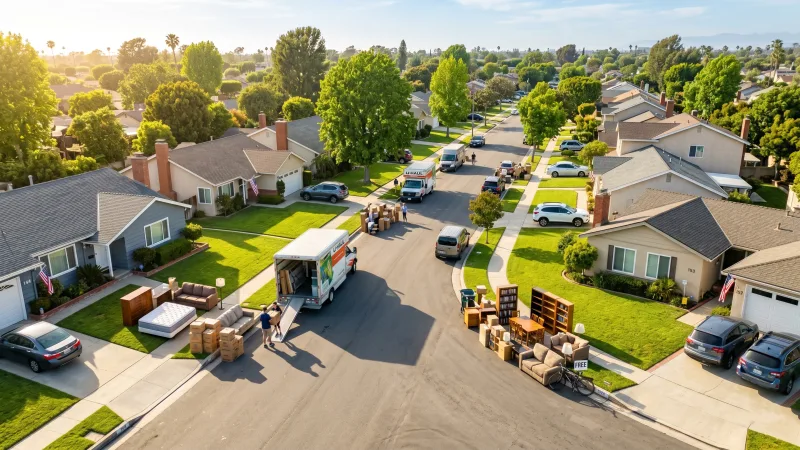
The last weekend of April is when Denver finally explained itself to me. I walked the same blocks I'd been walking all week and the whole neighborhood had turned inside out. Dressers on the parking strips. A futon frame leaned against a dumpster. A floor lamp standing upright on the sidewalk like someone had just set it down mid-thought. I asked a woman hauling boxes what was going on and she laughed at me. "First of the month," she said, like I'd asked why the sun was up.
Denver runs on first-of-the-month leases, and this city has been churning — people arriving, people priced out, people trading up to a place with in-unit laundry. All of it hits the curb in the 48 hours before the first. That weekend I found my dresser: a squat oak four-drawer, solid all the way through, dinged on top and missing one pull. Nobody had touched it. I carried it up two flights with the wood-glue neighbor, sanded the top, and swapped the pulls for $6 of brass knobs. It's the best-looking thing I own. I have a documented weakness for solid-wood dressers nobody else wanted, and this one confirmed it.
Week 3: RiNo, for the good stuff
By week three I'd heard River North — RiNo, to everyone — mentioned enough times that I took the bus up Larimer to look. Different economy entirely. RiNo is newer money, converted warehouses and glassy mid-rises, the kind of building where people redecorate because a design account told them to. The castoffs match: I passed a genuinely nice walnut-veneer credenza that was too big for my place and still think about it, and I came home with a small powder-coated metal side table and a rolled-up jute rug that only needed a shake and an afternoon in the sun.
One caveat about RiNo: the new buildings have loading docks and locked interior trash rooms, so a lot never makes it to a public sidewalk. The finds cluster around the older houses on the edges, toward Curtis Park, not the shiny cores. Walk the seams between old and new.
Week 4: The alleys, and Wash Park
The alleys were the real revelation. Denver is built on alleys — nearly every residential block has one running down the spine, and that's where the trash carts and recycling bins live. So that's where people set the giveaways too, right by the bins, not out front where you'd think to look. If you only walk the streets here, you are missing half the city's inventory. It felt like snooping the first time, cutting down a gravel alley behind Marion Street, but it's public right-of-way and it's where everything is.
I took that lesson south to Washington Park. Wash Park is older, leafier, more settled — families who've been in the same bungalow for twenty years and finally replaced the guest room set. Quality castoffs, less frequent than Cap Hill but a higher hit rate when they come. Behind a house near Gaylord I found a solid pine bookshelf and, sitting on top of it, a leggy overgrown pothos in a cracked pot that someone had clearly loved and couldn't move. It's on my windowsill now, thriving out of spite. Rescued houseplants are my other weakness. Denver keeps finding them for me.
Weeks 5 and 6: The sofa
I still had no couch, and you can't glue-and-clamp your way to a couch. So I finally used the app the way it's meant to be used instead of relying on my feet. I turned on alerts for furniture near Capitol Hill and started checking the map with my morning coffee. A gray three-seater popped up on a Wednesday, posted by someone two blocks over on Ogden. I was there in eight minutes. She was loading a U-Haul and looked at me like I'd been sent by the universe — "I was about to pay a junk company to take it," she said. We carried it to my van together. It has one faint coffee ring on the arm and I have never cared less about anything.
What Denver taught me that SF didn't
The dry air is a genuine advantage. In San Francisco, a wood piece left out overnight in the damp is a gamble; here the climate is dry and mild enough that furniture sits on a curb for a day or two and comes through fine. Don't write something off just because it's clearly been outside — check it, don't assume.
The move churn is your engine. This city grows and reshuffles constantly, and every arrival and departure is somebody's furniture hitting the pavement. Time your walks to the last weekend of the month and you'll do more in two days than in the other twenty-eight.
And Denver people are refreshingly unfussy about it. In SF the giving comes wrapped in a whole philosophy of sustainability and buy-nothing ethics. Here folks just set a decent chair by the alley bin because someone might want it, no ceremony. I mean that as a compliment.
By the end of week six the apartment was done. Everything but the bed frame and the French press came from within about two miles of my door. Total spend: a tank of gas, six bucks of drawer knobs, and the patience to keep looking down the alleys.