My upstairs neighbor Reza texted me a photo last April: a pretty little oak nightstand somebody had set out on Wabansia, dovetailed drawers and everything. By the time he'd walked the two blocks to grab it, a man in a white cargo van had already loaded it, plus a dresser and two dining chairs, and was reaching for a fifth thing. Reza came home with nothing. That van does a route. Same blocks, every Tuesday and Thursday, an hour before the trucks come, and the good stuff gets resold online by Friday.
Here's what I want to say plainly, because it would be dishonest not to: I refinish furniture too, and sometimes I sell it. I am, technically, a version of that guy. I just work very hard not to be that version.
Flipping isn't the crime. The route is.
There's a loud opinion online that anyone who resells free furniture is a parasite, full stop. I don't buy it. A cracked, water-stained sideboard that would've gone to the dump on Thursday, and instead gets clamped, sanded, oiled, and lived on for another forty years — that's a good outcome no matter who did the sanding. The wood got saved. Somebody learned a skill. Nobody was harmed.
The harm is a volume problem, not a resale problem. One person who grabs a genuinely great piece once or twice a month and puts real hours into it is playing a completely different game than someone who treats the whole neighborhood as free inventory and clears every pile before a normal person walking their dog even sees it. Same activity on paper. Opposite effect on the block. The van guy isn't wrong because he sells things. He's wrong because Reza got nothing, and so did the family two doors down, and so did everyone who wasn't up at 9pm with a truck.
What's actually worth carrying up three flights
Most of what sits at the curb is garbage, and I mean that technically. Learning to tell in ten seconds saves your back and your time.
The whole game is solid wood versus everything else. Solid oak, maple, walnut, teak, cherry — that sands, refinishes, and holds value. Particleboard and MDF with a printed woodgrain laminate does not, ever, no matter how clean it looks in a listing photo. Get rained on once and it swells like a sponge and there's no coming back. Flip a drawer over and look. Real wood has grain that runs through the edge; laminate has a paper-thin skin that chips off a crumbly gray core.
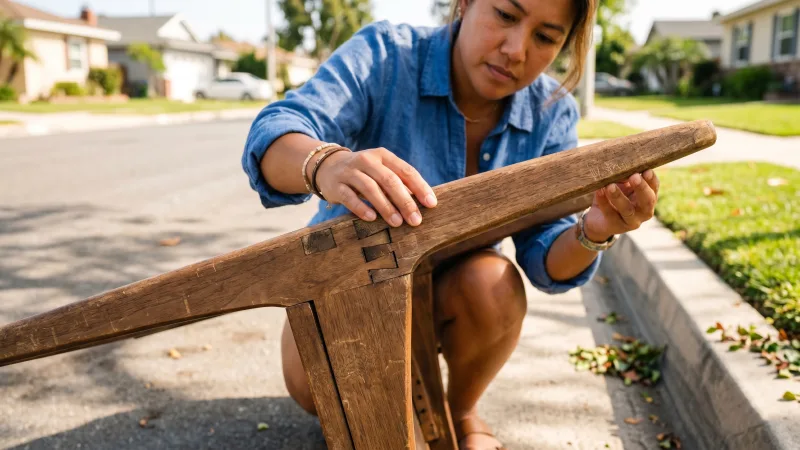
Then check how it's held together. Dovetail joints on the drawers — those little interlocking wedges — mean somebody built it to last. Dowels and mortise-and-tenon, good. Staples, brackets, and a screw driven straight through a thin panel edge, bad; that's flat-pack that already gave up. I carry a flashlight and a screwdriver on any real scouting walk (the light for drawer interiors, the screwdriver to wiggle a joint and see if it's loose or actually failing). And I do the thumbnail test: press a nail into an unfinished spot. If it dents easily, the wood's soft or water-damaged, and you're about to waste a weekend.
Leave the mattresses. Always. Leave anything upholstered that smells like anything, or has a stain you can't explain, because that's bedbugs and mildew money you don't want to gamble on. Solid-wood dressers, wood dining chairs (even a set with one bad leg), decent mirror frames, small bookcases with visible joinery — that's the stuff worth the stairs.
The refinishing part, honestly
You don't need a shop. My whole setup lives on a balcony: a $40 orbital sander, three grits of paper (80 to knock off the old finish, 120, then 220 to smooth), a can of mineral spirits, wood glue, one bar clamp, and a bottle of wipe-on Danish oil. Total, under a hundred bucks, and it's lasted me years.
The order matters. Glue and clamp any loose joints first, let it cure overnight, then sand — not the other way around, which I learned by sanding a chair beautifully and then discovering it wobbled. Sand with the grain, work up through the grits, wipe the dust off with a rag and mineral spirits, then two or three thin coats of oil with an hour between each. A small nightstand is maybe three hours of actual work spread over two days, most of it waiting for coats to dry.
Be realistic, though. That's the easy case. A dresser with three cracked drawer bottoms and missing hardware is a full weekend, and matching-era pulls will cost you $30 and an eBay search, and if you're honest about your hourly rate you might've been better off leaving it. Half the skill is knowing what to walk past.
Where I actually draw the line
I don't have a rulebook, but I have a few things I won't cross, and they've kept me on the right side of my own conscience.
I never take something posted "for someone who needs it." That phrasing is a request, and reselling it is just theft with extra steps. I don't clear a pile — if there are five chairs and I want one for a project, I take one and leave four. I put things back. When a restoration flops or I change my mind, that piece goes back out on the curb the same week, not into my garage to rot for a year. And if a buyer asks where a piece came from, I tell them the truth. A well-done rescue is nothing to be ashamed of. Lying about it just makes people trust secondhand furniture less, which hurts everyone doing this honestly.
The quiet rule under all of them: leave more than you take, over time. If I've pulled two good pieces off my neighborhood this month, I've also dropped a working lamp and a stack of books on the curb for whoever wants them. The pile is a commons. You don't get to be the only one drinking from it.
Sell it somewhere else, though
One thing I want to be clear about, because people get confused: you don't flip on CurbSofa. The whole point of the app is that money never changes hands — it's neighbors handing off stuff they're done with to someone who'll use it, and that's it. When I find a piece worth restoring, I browse the map exactly like anyone else, I go pick it up like anyone else, and then the reselling happens completely elsewhere: Facebook Marketplace, a booth at a flea, a local resale shop. Keep those two worlds separate. Treating CurbSofa pins as your personal wholesale supplier is precisely how you become the van.
Flipping curb furniture, done with restraint and a little craft, is one of the better small trades going right now. Low cost to start, a real skill you can actually feel yourself getting better at, and a genuinely good ending for wood that would otherwise be landfill. Just remember the nightstand Reza never got. The curb was never only yours.