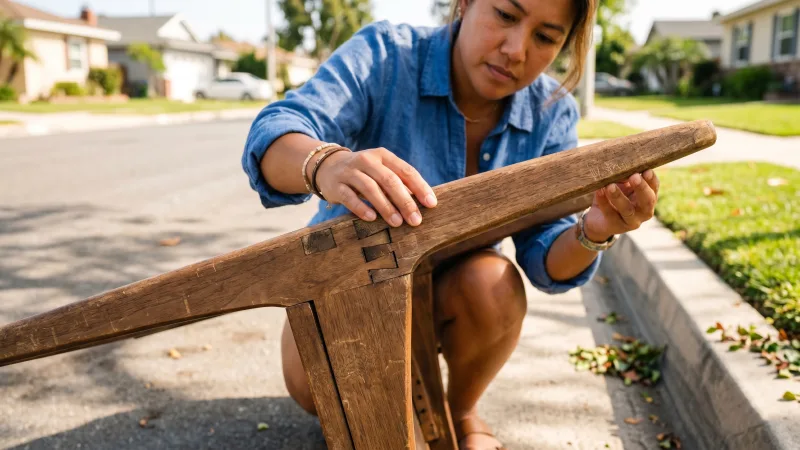
I want to tell you about a dresser. Not a specific dresser I own — this one's a composite, stitched together from a few real ones I've hauled, helped haul, or watched change hands over the years. But every detail here has happened to a piece of furniture somewhere, probably on a curb near you. Call it an honest fiction. The point of it is true.
It's a five-drawer oak dresser. Maybe forty inches wide, heavier than it looks, the kind of thing two people carry with a specific grunt on the third stair. Dovetail joints in the drawers, which is how you know somebody made it to last. Nobody remembers who bought it new. By the time our story starts, it already had a small ring stain on top from a coffee mug and a back panel held on with the wrong screws.
Home one: the first apartment
It landed in a fourth-floor walkup with a radiator that clanked all night. The tenant — first place of her own, twenty-three, working retail — found it on the sidewalk one Sunday morning, the good hour, before the truck comes. It had a cardboard sign taped to it: FREE, WORKS FINE, ONE STICKY DRAWER. She and a friend got it up four flights in about twenty minutes and one dropped end that left a fresh dent on the bottom left corner. That dent stayed. It became part of the thing.
The sticky drawer was real. The bottom one dragged like it was full of wet sand. She lived with it for eight months before her uncle showed her the fix: pull the drawer all the way out, rub a white candle — plain paraffin — along the wooden runners and the tracks they ride on. That's it. No hardware, no store trip. It slid like new and she felt like she'd performed surgery.
For three years that dresser held the archaeology of a first apartment. The top drawer was mismatched socks and a passport and a tangle of phone chargers that no longer matched any phone. The middle two were clothes. The bottom one — the formerly sticky one — was the junk drawer that a dresser isn't supposed to have but always ends up with: takeout menus, a hammer, birthday candles, a single mystery key.
Home two: the sage-green year
When she moved in with a partner, their furniture had a summit meeting and the oak dresser lost. His was newer. Hers went out to the curb again — except a coworker intercepted it first, which is the best way for these things to travel. No sidewalk gamble, just a text: you getting rid of that? I'll take it.
The coworker had opinions. Orange-toned oak wasn't her thing, so the dresser got its one and only repaint. A quart of sage-green — the kind of muted, slightly gray green that was everywhere that year — went on over a weekend. And here's where I have to be a nag, because most repaints I see go wrong for the same reason. She almost skipped the prep. She didn't, thank God. She scuff-sanded the whole thing with 220-grit, wiped it down, hit it with a bonding primer, then painted two thin coats. If you skip the sanding and primer on old sealed wood, the paint sits there like a sticker and peels off the first time a belt buckle drags across it. I've watched it happen. It's heartbreaking and completely avoidable.
She also swapped the knobs. The original round wooden pulls went in a jar in the closet (people always keep the old knobs; nobody knows why) and got replaced with little brass ones from the hardware store, about four dollars each. Same screw spacing, so it was a ten-minute job. New knobs and a coat of paint make a forty-year-old dresser look intentional. That's the whole trick, really — the difference between "someone's castoff" and "a choice."
Home three: the nursery
The sage dresser had a kid before its owner did, in a sense. When the coworker got pregnant, that dresser became the changing station. They screwed a contoured changing pad to the top — brackets on the back edge so it couldn't slide — and suddenly the five drawers held the smallest clothes I've ever seen folded. Onesies with snaps. Socks the size of a thumb. A drawer that was nothing but muslin blankets and a white-noise machine.
This is the era that saved it from the landfill, I think. A dresser you've changed a hundred diapers on at 3 a.m. is not a dresser you toss. It gets grandfathered into being family. When the kid outgrew the changing pad, they unscrewed it, and the four little holes on top got filled with a dab of wood filler and forgotten under a lamp.
Home four: the college kid
Eighteen years is a long time for anything to stay useful. When that same kid left for school, the dresser went too — into a dorm-adjacent apartment with three roommates and no rules. The sage green was chipped at the corners by now, worn down to bare wood on the edges where hands and hips had brushed it a thousand times. Which, honestly, looked great. You can't fake that. People pay for a "distressed finish" and here it was for free, earned.
Now it holds hoodies, mostly. A tangle of phone chargers that don't match the phone (see: home one — some things are eternal). One brass knob has gone missing and been replaced with a mismatched black one, and instead of hunting for a match the kid just leaned into it and made all five different. The dent on the bottom left corner from that first stairwell is still there, painted over twice, a little fossil from before he was born.
Why the dresser never lost
Here's what gets me. At four separate moments, that dresser was one lazy decision away from a dumpster. Four times, somebody chose the twenty minutes and the flight of stairs instead. A candle fixed the drawer. Prep and a quart of paint bought a second life. Four-dollar knobs bought a third. None of it was hard. None of it cost much.
Americans throw out millions of tons of furniture a year, and the sad part is how much of it is solid, dovetailed, dented-but-fine stuff that just needed a knob or a candle or a ride. A particleboard flat-pack dresser genuinely can be at the end of its road at eight years old. This one's pushing fifty and holding hoodies.
So when you're standing over something on your own curb, or scrolling past a free dresser on the map, do the math the way that first tenant did on a Sunday morning. Is it solid wood? Do the drawers have real joints? Is the only problem a stuck drawer or a color you don't love? Because those aren't problems. Those are a Saturday. And the thing you save might outlive all of us, quietly holding somebody's socks.