Three summers ago I hauled a gorgeous green road bike up four flights of stairs. It had a leather saddle, skinny tires, and a vintage sticker on the seat tube. I was thrilled for about a day. Then I noticed a hairline crack in the paint where the down tube meets the head tube, and when I pressed on it with my thumbnail the paint flexed. Steel, luckily, but cracked is cracked. A shop quoted me a weld and repaint that cost more than a decent used bike. I carried it back down. Four flights. Don't be me.
So here is the inspection I do now. It takes about five minutes, needs no tools, and has saved me a lot of stairs.
Start with the frame, because the frame decides everything
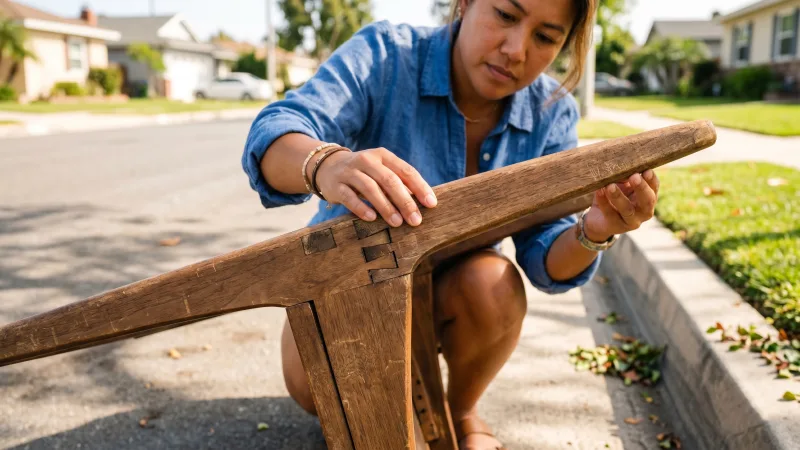
Almost every other part on a bike can be swapped for cheap. The frame can't. Crouch down and look at the places where tubes join: the head tube at the front, the bottom bracket where the pedals attach, the seat stays, and the dropouts that hold the rear wheel. You're looking for hairline cracks, wrinkled or rippled paint, and dents in the tubes.
Wipe off grime with your thumb first. Dirt hides cracks, and a clean thumb swipe along a weld is the fastest test I know. Rust is fine to see on steel. A crack is not. On aluminum or carbon a crack is an automatic pass, full stop. Nobody sensible repairs those, and a failed frame at speed is how people end up in the ER. Carbon is trickier, since damage can hide under a nice finish. If a carbon bike has any ding, any weird soft spot, any crunchy sound when you squeeze the tubes, leave it.
The fork and the front end
Stand over the front wheel, grip it between your knees, and try to twist the handlebars. They should turn together with the wheel. If the bars slip, that's a loose stem, usually a thirty-second fix with an Allen key.
Now look at the fork from the side. The two blades should curve forward in a smooth, matching arc. If one leg looks kinked, or the front wheel sits oddly close to the down tube, the bike took a hit. Roll it forward and slam the front brake. Any clunking in the headset (that is the bearing assembly at the top of the fork) means a bearing job, which is doable but not free. A bent fork is a pass. A bent steerer tube, the part that goes up into the frame, is a hard pass.
Wheels, tires, and the spin test
Lift each wheel and spin it, watching the gap between the rim and the brake pads. A little wobble is normal and a spoke wrench fixes it. A big side-to-side hop, or a rim with a visible flat spot or dent, means a new wheel. Squeeze a few spokes. Loose, clanking ones are okay. A broken spoke is okay too, for a few dollars.
Tires tell you how long it's been sitting. Look at the sidewalls for fine cracks, like a dry riverbed. That's dry rot, and those tires are done. New tires and tubes are cheap, though, so treat it as a shopping list item, not a dealbreaker. Same for flat tires. A flat just means a tube.
Brakes, chain, and the things that seize
Squeeze the levers. They should feel springy and pull the pads against the rim. Mushy levers usually mean a stretched cable. Cables cost a few dollars, pads a few more. Check that the pads aren't worn smooth or hardened like old erasers.
The chain is where rust fools people. Surface rust, that orange dusting after a rainy month, rubs off with a rag and some degreaser. A chain that's stiff, with links that won't bend when you flex it by hand, is rusted solid and needs replacing. Chains are cheap. A rusted cassette and chainrings, the gears themselves, are more money and a good reason to keep walking.
Last, the stuff that gets stuck. Try to twist the seat post and see if it moves. Then check the stem. A seized seat post, welded in by corrosion, can take a lot of penetrating oil and patience, and sometimes a shop with the right tools. I once spent an entire Saturday on one and lost. If you can't adjust the saddle height and you're not feeling stubborn, move on.
What it costs, honestly
Free is not zero. A bike that passes the check above usually still wants a tune-up, and shop tune-ups run somewhere around eighty to a hundred and fifty dollars depending on where you live. Parts like tubes, a cable, brake pads, and a chain add up to maybe fifty. If a bike needs a new rear wheel, a chain, tires, and a tune-up, you may be better off with a used bike that someone already sorted out. For me, the sweet spot is a bike that needs under about thirty dollars of parts and an afternoon with YouTube and a basic tool set.
Kids' bikes and scooters are the easy wins. Kids outgrow them long before they wear out. Check the frame, the wheels, and the brakes, and for scooters check the folding mechanism and the deck for cracks. Exercise bikes are different: they weigh a ton, and the main failure points are the pedals, the console, and the resistance mechanism. Turn the flywheel by hand and listen for grinding. If it's smooth, you've got a sturdy coat rack that also works as an exercise bike.
Skip the helmet, and think twice about a nice bike
If there's a helmet sitting with the bike, leave it. You can't know whether it was in a crash, and the foam inside can be crushed and useless with no visible sign. Even an unfallen helmet ages out. A new one is a small price against your head.
One more thing. If an expensive-looking bike is out front with no note, no sign, and no explanation, pause. Bikes get stolen and dumped, and a nice one parked against a pole is just as likely to be someone's locked-up ride as a giveaway. I stick to bikes that are clearly offered: a free sign, a post on the curb listing, a neighbor who tells me it's theirs to give. If you're unsure, ask, or don't take it. It's okay to walk away from a great bike if the story feels off.
If you want to find bikes that people have clearly listed as free, check the map near you. That clarity is half the reason I look there first. And if you leave one for someone else, say plainly that it's free, mention what's wrong with it, and take a photo of the frame. The next person with a thumbnail and five minutes will thank you.