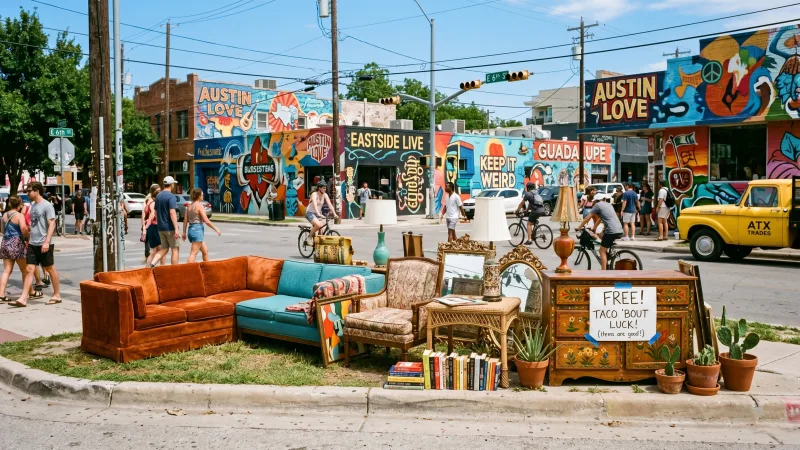
I have a bad habit of taking the long way home so I can look at what people put out. My partner calls it snooping. I call it reading. Because that's what it is, honestly — the curb is a kind of open notebook, and if you slow down for it, a neighborhood will tell you almost everything about itself before you've knocked on a single door.
I didn't set out to learn this. It happened the way most useful things happen, sideways, over years of walking the same few square miles and paying attention to the wrong details. But once you start seeing it, you can't stop.
The furniture has a calendar
Move to any street near a university and wait for the last week of May. The transformation is almost comic. Suddenly every third house is bleeding particleboard — the flat-pack bookcases with the little cam locks stripped out, the MALM dressers with one drawer riding crooked, the futon frames that never fully forgave anyone. IKEA furniture doesn't die so much as it graduates, and in a college town it graduates all at once.
I lived two blocks from a campus for six years, and I could have set a clock by it. Late August, the sidewalks fill back up with the same species of thing, minus one summer's worth of wear, dragged in by parents in rented vans. It's the same objects doing laps. The street was recycling a generation of students through the same twelve bookshelves, and nobody planned it. It just happened, because that's the rhythm of that kind of life — cheap, portable, temporary, and completely fine with being all three.
Contrast that with the blocks where nothing moves for years and then, one weekend, everything does. Those are the estate blocks.
What the older streets leave behind
There's a particular kind of curb pile you learn to recognize in an older neighborhood, and it always makes me a little quiet. It's never flat-pack. It's a heavy oak dresser with dovetailed drawers and a mirror gone cloudy at the edges. A sewing table. A recliner with a permanent dent in the shape of one specific person. Boxes of things that were clearly kept on purpose — cake pans, a card table, a shoebox of Christmas ornaments wrapped in newspaper from a decade nobody remembers.
You don't need the backstory. The pile is the backstory. Someone downsized, or someone moved into care, or someone died, and now their kids are standing in a driveway on a Saturday deciding what a whole life is worth by the cubic foot. It's brutal and ordinary and it happens on a thousand streets every week.
I took a dresser off one of those piles once. Solid maple, 1950s maybe, drawers that slid like they were on butter once I waxed the runners. There was a strip of contact paper lining the bottom drawer, a faded lemon-yellow floral, cut carefully to fit. Somebody measured that. I never took it out. It's still in my bedroom, holding my sweaters, lined with a stranger's careful yellow flowers. That's the thing nobody tells you about curb furniture — you don't just inherit the object, you inherit the small evidence of the person who loved it enough to line a drawer.
The stuff that tells you about the babies
Then there's the gear that's barely used, and that has its own story too. Pack-n-plays, Bumbo seats, those elaborate bouncers with the jungle animals, high chairs still sticky in the crevices — put out looking almost new because babies are ruthless about outgrowing things. A family hits the far side of a stage and the whole apparatus of it goes to the curb in a single afternoon, relieved.
You can date a young family by their castoffs the way you'd read tree rings. First the changing table. A year later the crib, converted or not. Then the tiny plastic potty, which is the one nobody ever wants to talk about at the curb but which absolutely appears. Each item is a milestone somebody was probably a little emotional about, disguised as junk.
When a company falls, the chairs come out
My favorite tell, though, is corporate. When a startup folds — and in some neighborhoods they fold in clusters — you get a very specific curb event: a sudden crop of ergonomic office chairs. Aeron knockoffs, the good adjustable ones, six or eight of them at once outside a building that isn't residential. Sometimes a whiteboard on wheels. Sometimes a sad little kitchen's worth of matching mugs.
I saw it happen near an office district in the spring of a bad funding year. One week the sidewalk grew a small herd of task chairs, all facing different directions like they'd been startled. Someone's Series A ended up under my desk, and I've been sitting in it while I write this. It's a great chair. It cost that company a lot more than it cost me, which was nothing.
The exchange was always here
None of this is new. People have been reading their streets and quietly reclaiming each other's leftovers for as long as there have been streets and leftovers. The curb has always been the oldest, most honest marketplace we have — except no money changes hands and nobody's trying to sell you anything. You just have to be walking by at the right moment, which is mostly luck.
That's the only part CurbSofa really changes. It doesn't invent the exchange; it just makes the timing less cruel. Instead of the dresser sitting out through a rainstorm because the one person who'd have loved it took a different route home, it shows up on the map, and that person sees it from their couch. Same old street economy, minus the luck. The lemon-yellow drawer liner finds its next bedroom.
I still take the long way home. I still read the curbs. But now, when I pass a good solid thing that deserves better than a landfill, I don't just feel that small pang of somebody should take that. I take a photo. Because somebody will — and I like knowing I helped the object skip the part where it gets rained on, waiting to be found.