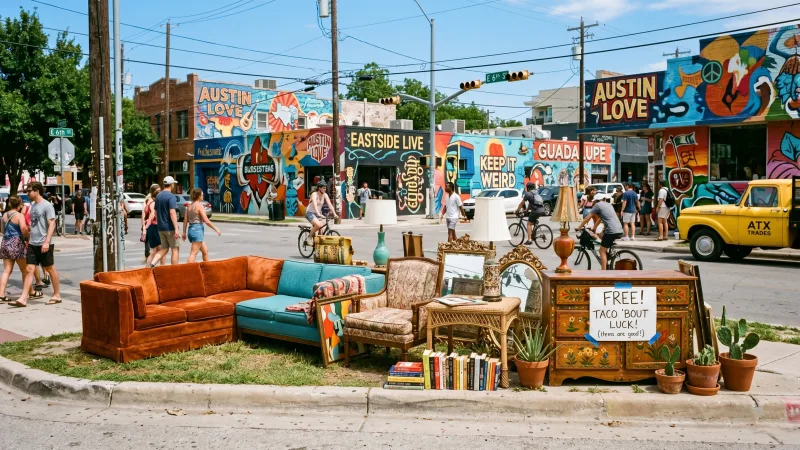
When we started CurbSofa, we drew circles around a dozen or so metros — Los Angeles, San Francisco, Seattle, New York, Chicago, and a few more — and if your pin landed outside one of them, the app basically shrugged and said "not in your city yet."
I understood why we built it that way. Launching narrow lets you keep a map from looking empty. But it always bugged me, because the whole premise of CurbSofa is that free stuff shows up everywhere. A perfectly good dresser gets left on a curb in a small Ohio town just as surely as it does in Brooklyn. Telling someone in that town "sorry, we're not here yet" was the opposite of what I wanted this to be.
What changed
As of now, the city gate is gone. If you're anywhere in the United States, you can post a free item and it goes straight onto the map for your neighbors. No waiting for us to "open" your city. No picking your metro from a dropdown. You drop a pin where you left the couch, and people nearby can see it.
A few practical things that come with this:
Post from where you actually are. The app checks that you're standing near the item when you post it — within about 500 feet — so listings stay honest and local. You'll see a circle on the map showing exactly how close you need to be.
We figure out the location for you. You don't tell us your city anymore; the pin does. Whether you're in Austin or a town most maps forget, your item lands in the right spot.
Finding works the same way. Open the map, see what's near you, go grab it. First come, first served, same as it's always worked on the curb.
If your town looks empty, that's the opportunity
Here's the honest part. In the metros we started with, there's already stuff on the map most days. In a lot of the country, there won't be — yet. A map is only as good as what people put on it, and CurbSofa in your town starts the day someone decides to use it.
So if you're in a smaller city or a suburb and you've got something sitting in the garage you keep meaning to deal with, this is the nudge: post it. Set it out, drop the pin, and you've just put the first thing on your town's map. The person who grabs it will remember the app the next time they have something to give away. That's the whole flywheel — it just needs a first turn.
The same goes for finding. The more people in an area who are checking the map, the faster givers get a reason to keep posting. Even opening the app and poking around your neighborhood helps, because it tells us where the interest is.
Why this matters to me
CurbSofa exists because of one table on a curb in Los Angeles that I almost walked past. The thing I couldn't stop thinking about afterward wasn't the table — it was how many of those moments were quietly disappearing into garbage trucks because nobody knew the item was there in time.
Keeping that to a dozen cities never made sense. Furniture waste isn't a big-city problem; it's an everywhere problem. Roughly twelve million tons of furniture head to US landfills every year, and a huge share of it is perfectly usable. The fix isn't complicated. It's just visibility — letting the person who needs a bookshelf find the one their neighbor left out three blocks away.
Now that can happen whether those three blocks are in Manhattan or in a town of four thousand people. That's the version of CurbSofa I wanted to build from the start.
Give it a try in your area. Post the thing you've been meaning to get rid of, or open the map and see what's around. Give it a new home, not a landfill — wherever home happens to be.