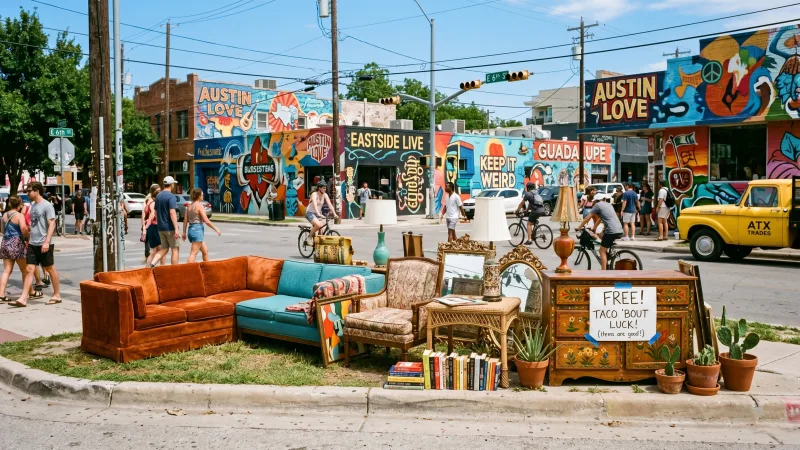
I grew up outside a town in Ohio with one stoplight and a Dairy Queen that closed for the winter. So when people talk about curb culture like it's a Brooklyn thing — a Poäng chair appearing at 84th and Columbus, gone in twenty minutes — I want to gently push back. My grandmother gave away half her kitchen over forty years and never once put anything at an actual curb. She didn't have one. What she had was a folding card table at the end of the drive, a sheet of notebook paper that said FREE in marker, and a phone that rang when someone needed a card table more than she did.
Small-town and suburban curb culture is alive. It just runs on different rules. The biggest one: nobody is walking by. In a dense neighborhood, foot traffic does the advertising for you. Out here, if a stranger is going to end up with your old dresser, something has to actively point them toward it. That single fact changes everything about how giving works.
The driveway table beats the curb, every time
The move in the suburbs isn't the curb at all — it's the end of the driveway, angled so it's visible to cars slowing for the stop sign. My neighbors in the cul-de-sac years I lived in outside Columbus figured this out collectively without ever discussing it. You put stuff where a driver going 25 can actually register it and pull over. A cardboard box on the ground behind a mailbox? Invisible. A bookshelf standing upright with a bright FREE sign taped at windshield height? That's gone by Sunday dinner.
Weekends are the whole game. Saturday morning and — this is the one people underuse — Sunday afternoon, when the yard sales have wrapped and everybody's got a pile of stuff that didn't sell. Around 2 or 3pm on a Sunday, driveways all over my old subdivision would sprout "FREE — leftovers" signs. That's the honey hole. People priced things at a dollar all morning, got tired, and would genuinely rather you take the lot than haul it back into the garage. I got a working Craftsman toolbox that way. Empty, sure. Still have it.
The bulletin board is the local internet
Before anybody says "just post it online," remember that a real chunk of rural and small-town America is older, and the trusted channel isn't an app — it's a cork board. The one at the church vestibule. The one by the door at the IGA or the feed store. The laminated notices at the library. My aunt has given away three recliners, a chest freezer, and a literal piano through the bulletin board at her Methodist church, and she'd sooner drive the freezer to the dump than figure out Facebook.
If you're the younger person in the family, this is a genuinely useful job you can do: be the bridge. Take a photo of grandma's sideboard, and post it where the young people are, while she works the board where her people are. You'll be shocked how fast a solid-wood dresser moves when it hits both.
Buy Nothing goes country
The the map version of this — everything pinned so you can see what's free near you — solves the exact problem small towns have, which is that you can't see around the bend. But the older backbone is Buy Nothing groups, and they've quietly spread way past the cities. Rural and small-town Buy Nothing groups tend to cover a whole county instead of eight square blocks, so "local pickup" might mean a 20-minute drive. That sounds like a downside. In practice it's fine, because the trust runs deeper. In a group of 300 people who all know somebody who knows you, nobody's going to no-show your porch pickup and ghost. Reputation is a real currency when the town is small enough that your kid plays ball with theirs.
Freecycle, the granddaddy of all this, is also still hanging on in rural chapters where Facebook never fully took over. Worth a search for your county name plus "Freecycle" — you might find a sleepy little email list that's been quietly rehoming lawnmowers since 2006.
Word of mouth is the fastest network there is
Here's the thing city folks miss: in a small town, the fastest way to get rid of a good dining set isn't any of the above. It's telling one well-connected person. Mention at the diner that you're clearing out your mom's house and by the following week three families have asked about the hutch. The gossip network people complain about is the same network that finds a home for a crib in an afternoon. Lean into it. Tell the mail carrier. Tell the woman who does everybody's hair. They know who just had a baby, who's setting up a first apartment, whose barn burned.
Tips when your curb is a country road
A few things I've learned, some the hard way:
Give the timeframe. Since stuff can sit for days, add "out until Sunday eve" to your sign or post, so nobody wonders if that chair's been rained on for a week. And weatherproof it — a couch left out through a Tuesday thunderstorm isn't a gift anymore, it's a soggy problem you handed a stranger. Cushions inside, or a tarp, or wait for a dry stretch.
Photos do the walking. With no foot traffic, a clear photo is your only shop window. Shoot it in daylight, show the actual condition, and measure the big stuff — nothing worse than someone driving 25 minutes for a table that won't fit their car or their nook.
Pin it so people can find it. The single biggest disadvantage out here is discoverability, so put your giveaway somewhere searchable, not just at the end of an unmarked lane. A dropped pin turns "somewhere on Route 9" into an actual address.
Finders: expand your radius and lower your urgency. The rhythm is slower. Check on a Sunday. Be willing to drive 15 minutes. And take the whole box — the person who left "free leftovers" wants an empty driveway, and clearing the lot makes you the neighbor they call first next time.
My grandmother's card table is at my place now, incidentally. Somebody gave it back to the family a few years after she passed — recognized it, knew whose it had been, drove it over. That's the part that doesn't happen in a city of eight million. Out here, the stuff has a memory, because the people do.