There was a bread machine on the top shelf of my hall closet for four years, and in that entire time I baked two loaves. The first was dense and slightly raw in the middle. The second was better, honestly — a decent whole wheat, January of some year I can't place now — and then I never made a third. The machine sat up there in its original box, which I had kept, because part of me believed the box was proof the machine still meant something.
I'm the person who edits other people's decluttering stories for this site, which makes the bread machine a little embarrassing. But I've stopped thinking of it as a personal failing and started thinking of it as ordinary, almost universal. Nearly everyone I know has a version of it. The pasta maker. The exercise bike with a scarf draped over the handlebars. The kayak in the garage. We keep these things not because we use them but because letting go of them requires answering a question we'd rather not: why did I want this in the first place, and who was I planning to become?
The good money problem
The bread machine cost around eighty dollars. I remember that with more clarity than I remember either loaf, which tells you something. Every time I considered getting rid of it, a small accountant in my head would clear his throat: you paid good money for that.
This is the sunk cost trap, and knowing its name does almost nothing to loosen its grip. The eighty dollars was gone the day I bought it. It was gone whether the machine baked a thousand loaves or sat in a box growing a fine coat of closet dust. Keeping it did not bring the money back. Keeping it just meant I got to postpone admitting I'd spent eighty dollars on a version of my life that never arrived — the Sunday-morning version, flour on my hands, the smell of it filling the kitchen. That woman was lovely. She also was not me, and I think I knew it by loaf number two.
The maddening thing is that the more something costs, the harder it is to release, even though the price has nothing to do with whether you'll ever touch it again. A twelve-dollar spatula you never use goes in the giveaway pile without a second thought. An eighty-dollar appliance stages a hostage negotiation.
The someday story
Right next to sunk cost lives its cousin, and this one is sneakier because it wears the mask of practicality. I might need it someday.
Someday I'll get back into baking. Someday the grandkids will visit and want pancakes shaped like animals. Someday there'll be a blackout and I'll be so glad I kept that camping stove. The someday story feels responsible, even virtuous — like you're the prepared one, the person who thinks ahead. But most somedays never come, and the few that do arrive can almost always be met by borrowing, or buying the thing again, or simply doing without. I have never once, in a genuine moment of need, thought: thank God I held onto that for four years.
What the someday story really protects isn't the future. It's the identity. As long as the bread machine was in the closet, I was still, technically, a person who might bake bread. Giving it away meant closing that door and admitting the door had been closed for years anyway. I just hadn't wanted to hear it click.
Objects are never just objects
Some things are harder than a bread machine, and I don't want to pretend otherwise. My grandmother's chair — a heavy carved teak thing that came over from Kerala, uncomfortable in every measurable way — I will never give up, and I'm not going to lecture anyone about it. That chair isn't furniture. It's her. It's the smell of coconut oil and the particular way she sat with one foot tucked under her. Keeping it is not clutter. It's grief with a place to rest.
The trouble is that we let the teak chair logic bleed onto the bread machine. We treat the eighty-dollar appliance as though it, too, holds someone's ghost, when really it holds nothing but the memory of a Tuesday at a big-box store. Learning to tell the difference — this object carries love, that one only carries guilt — is most of the work. And guilt is the heaviest thing in any closet. Guilt over the money, over the ambition that fizzled, over the well-meaning aunt who gifted you the thing you never wanted. The object becomes a small daily reminder that you are, in some minor way, a disappointment. So you shut the closet door. Out of sight, guilt managed. For now.
Why the donation bin doesn't break the spell
Here's what I finally figured out, and it surprised me. I'd tried to get rid of the bread machine before. I'd put it in a bag for Goodwill twice and both times carried it back inside. Because dropping it in a donation bin felt, weirdly, like throwing it away. Into the maw it goes, off to some warehouse, maybe sold, maybe pulped, I'd never know. The bin absorbs your guilt but it doesn't resolve it. You're just relocating the object to a place you can't see.
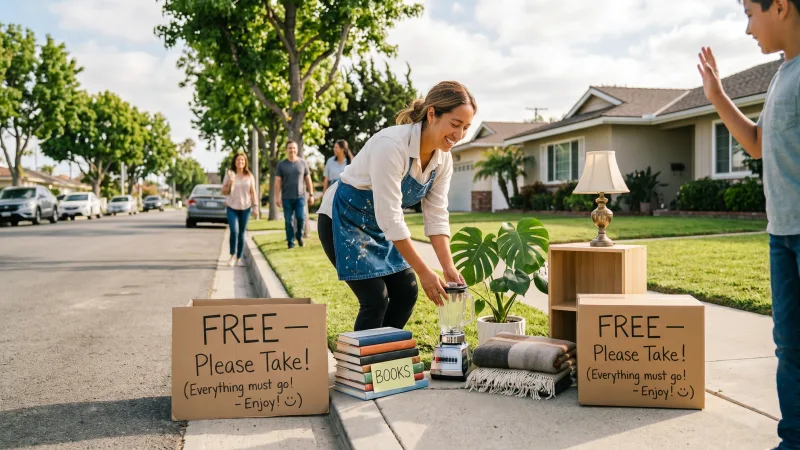
What actually broke the spell was a neighbor. I finally listed the machine on the map one Saturday morning, box and all, and by noon a woman named Renata from two streets over was standing on my porch. She'd just moved here from Porto, she told me, and she baked constantly, and she said the word broa — a Portuguese corn bread — with such delight that I felt the last four years rearrange themselves. I watched her carry my bread machine down the block, both arms around the box, and something in my chest genuinely unclenched.
It wasn't gone. It was going somewhere — to a specific person who wanted it more in five minutes than I had in four years. The eighty dollars didn't matter anymore. The someday I never lived was going to be Renata's every Sunday. You cannot get that from a landfill, and you cannot quite get it from a bin. You can only get it from watching a real human walk away happy with the thing that was quietly making you miserable.
The trade I didn't expect
I gave away the chair too, eventually. Not the teak one — a spindly reading chair I'd convinced myself I'd reupholster, fabric bought and everything, staples never touched. A guy named Devon took it for his daughter's first apartment. The fabric went in the bag with it. Godspeed to that project; it's his now.
I won't pretend I've become some serene minimalist. My closet still holds things I can't defend, and I'm at peace with a certain amount of that. But I've stopped confusing keeping with caring. If something is sitting in a box being a monument to a life you're not living, the kindest thing you can do — for the object, for the person down the street who actually wants it, and honestly for yourself — is to open the door, take a photo, and let a neighbor carry it off into a Sunday you were never going to have. The spell breaks the moment you see whose hands it lands in.