There's a floor lamp in my living room I found on 84th and Columbus at 11pm on a Thursday. Brass, pharmacy-style, 1970s, shade intact — the kind of thing that goes for two hundred bucks in a Williamsburg vintage shop. I carried it six blocks on my shoulder like a javelin, apologized to a man walking a greyhound, and got it up two flights before I remembered my keys were sitting on the kitchen counter. Worth it. Still have it.
That lamp taught me the thing nobody tells you about free furniture in New York: finding it is easy. The city hemorrhages good stuff onto the sidewalk every single day. The whole game is getting it home when you don't own a car, you live in a fourth-floor walk-up, and the couch you want weighs more than you do.
Stooping is a real hobby now
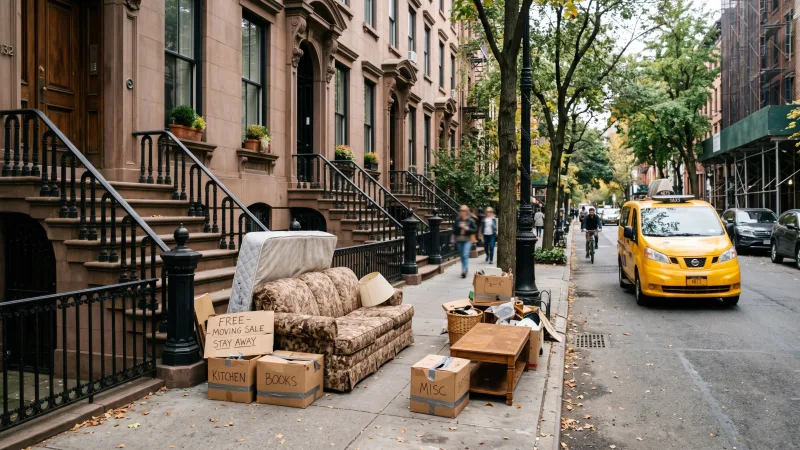
New Yorkers have a word for this: stooping. As in the stoop — the front steps of a brownstone where people leave the things they no longer want. Somewhere around 2019 it stopped being something you did quietly and turned into a whole culture. There are Instagram accounts with hundreds of thousands of followers doing nothing but reposting "corner of Bergen and Fourth, midcentury credenza, GO." People race for this stuff. I once watched two strangers negotiate custody of an Eames-ish lounge chair on a Clinton Hill sidewalk like it was a hostage situation.
So you're not the only one looking. In the good Brooklyn blocks a decent dresser can be gone in under ten minutes. Speed beats taste. Decide fast, move faster, and don't stand there overthinking a bookshelf while someone else walks toward it.
Carrying big things by yourself
Here's what I actually own and actually use.
A folding hand truck. Aluminum, folds flat, thirty-five bucks at any hardware store on any avenue. This is the single most important object a car-less New Yorker can buy. With a hand truck and two bungee cords I've moved a five-shelf bookcase from Park Slope to my place in Crown Heights alone, on the subway, without asking a soul for help. Conductors wave a loaded hand truck right through — it reads as "person moving," not "person hugging a table," and that's a distinction the MTA cares about more than you'd expect.
Bungee cords. Bring three even when you think you need one. A bookshelf that won't sit still on the hand truck becomes a two-cord problem, and then it's solved. They weigh nothing. I keep them in my bag permanently.
For small things — lamps, chairs, mirrors, framed art — the subway is fine. Hold it in front of you, not beside you (narrower), wait for the emptier car, board through a door and not the middle. Dining chairs go upside-down over your shoulder. You'll look deranged. It works. Nobody on the 1 train at 11pm cares what you're carrying.
For a sofa or a bed frame, stop pretending you're a hero. This is what GoShare and Dolly exist for: you book a guy with a pickup on your phone, he turns up in an hour or two, and fifty to ninety dollars later the thing is in your apartment. Against the price of a new couch, that's not a decision, it's a rounding error. The friend with a van is free but expensive in favors, and there are only so many times you can call him before he stops picking up.
Know when to walk away
Now the part that'll save you. Not everything on the curb is a gift. Some of it is a problem someone else is trying to hand off.
Bed bugs. I'm not being squeamish — New York has more of them than anywhere in the country, and upholstered furniture is exactly how they travel. My rule, learned the expensive way after a friend dragged home a "perfect" armchair off Metropolitan Ave: I don't take couches, mattresses, box springs, or upholstered chairs off the curb. Ever. Not the ones that look spotless, and especially not the ones with a "FREE - CLEAN!" sign taped to them (that sign is a warning, not a reassurance). If you truly can't resist something soft, check the seams and the underside for tiny dark specks first, and don't bring it inside — leave it in the hallway, look it over in daylight, then decide. Hard furniture is the safe game. A solid oak dresser can be wiped down and trusted. A cushion cannot.
The other walk-away test is honest math. That gorgeous marble table on the sixth floor of a walk-up in Washington Heights is not free — it costs your spine. Before you fall in love, find out what floor it's on, whether there's an elevator, and how far you're really carrying it. I have a personal cap: I'll walk anything up to a floor lamp about twelve blocks on foot, and past that I need wheels or a truck. The number's arbitrary. Having a number is not. Set yours before you're standing over a bookcase you can't get home.
The first of the month is the whole ballgame
Most of the country has a moving season. New York has a moving day, and it's the first — leases turn over on the first of the month and the churn is enormous. The big one is September 1st, when a huge share of the city's leases end at once and the sidewalks become the largest unsorted estate sale on earth. The last week of August, entire apartments come down to the curb block after block. May 1st and June 1st run a close second. If you want the pick of the year, walk a residential block in brownstone Brooklyn on August 30th around dinnertime and just look.
College move-outs stack on top of all this — late May and June around Columbia up in Morningside Heights, NYU in the Village, Fordham in the Bronx. Students leave behind furniture that's a year old because shipping it home costs more than replacing it. And every neighborhood has a bulk-trash night; the city posts the schedule by address on nyc.gov, and the evening before is prime hunting.
Where to actually walk
Brownstone Brooklyn is the best return on effort in the city. Park Slope, Carroll Gardens, Clinton Hill, Fort Greene — wide sidewalks you can load on, high-quality castoffs, and the stoops that gave stooping its name. The catch is the competition, plus the fact that Park Slope will make you carry a couch down a whole block of parked cars. Astoria and Long Island City in Queens are quietly excellent and far less hunted, with steady turnover from people who move for work. And the Bronx, near Fordham especially, is the most overlooked borough there is — the items are there, the crowds mostly aren't. Manhattan (the Upper West and Upper East Sides, Hell's Kitchen) has the best stuff and the shortest window; blink and it's already on someone else's hand truck.
How I hunt now
For years this was pure luck. Right block, right minute — or you saw it on Instagram twelve hours after it was gone. The finding was always the hard part. Not the carrying. The finding.
That's the piece that's finally fixed. When something lands on the map two blocks away four minutes ago, you don't debate it. You put your shoes on, grab the hand truck on the way out the door, and sort the logistics while you walk. In a city where the window is ten minutes, seeing it in real time is the entire advantage. The lamp on 84th was luck. The next one doesn't have to be.