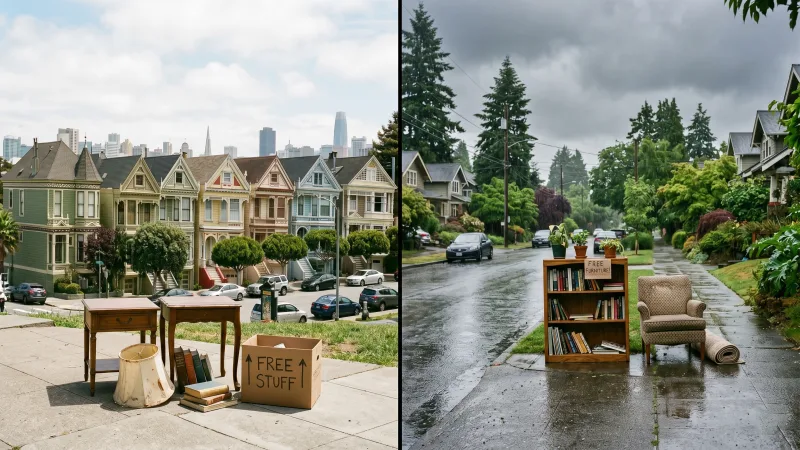
My neighbor Marcus left for Seattle on a Tuesday. I know because I ran into him in the lobby that morning with one rolling carry-on and a laptop bag. He said he had a job offer he couldn't turn down. By Thursday, when I walked past his unit, there was a note on the door from the building manager about move-out procedures.
By Friday morning, a near-mint Herman Miller task chair, a mid-century teak bookshelf, and a box of kitchen equipment — a Vitamix, a French press, a cast iron skillet — were sitting on the sidewalk outside our building. All of it was gone before noon. I got the cast iron. I still cook with it.
Marcus's situation wasn't unusual. In the six years I've lived in the Mission, I've watched the street cycle through dozens of versions of his story: a tech layoff, a visa expiry, a company acquisition and relocation. Each time, someone leaves with a suitcase. The apartment's contents go to the curb. Within hours, the neighborhood absorbs them. It's informal infrastructure that runs on economic instability — and it's uniquely, specifically San Francisco.
The Three Waves: When SF Curbs Flood
San Francisco's curbside scene isn't random. It pulses in predictable rhythms, driven by economic cycles that anyone who lives here long enough comes to recognize.
Wave One: Tech Layoffs — January and July
The tech industry runs on two hiring cycles: post-New Year and post-midyear performance reviews. Which means layoffs tend to cluster in January and July. These aren't small numbers — when a company announces 10% headcount reductions, that's thousands of people in the Bay Area making rapid housing decisions. Visa holders on H-1B status who lose their jobs have as little as 60 days to find new employment or leave the country. The furniture doesn't come with them. In January and July, the curbs in SOMA, Potrero Hill, and Mission Bay — neighborhoods dense with tech workers — are extraordinarily productive.
Wave Two: Semester End — May and June
SFSU, UCSF, UC Berkeley across the Bay, USF — the academic calendar drives a second distinct wave in late May and through June. Graduate students, visiting researchers, and undergrads in shared housing leave behind an enormous volume of items. This wave skews differently from the tech layoff wave: more IKEA, more functional-over-stylish, but enormous volume. If you're furnishing a first apartment and care more about function than aesthetics, late May is your season.
Wave Three: Fiscal Year Moves — December and January
A quieter wave, but reliable. Companies with December fiscal year-ends trigger relocation packages that push employees out of Bay Area apartments in December and January. Combined with the post-holiday impulse to purge, this window produces a consistent stream of quality items — particularly in wealthier neighborhoods where relocation packages are most common.
A Translator's Guide: What SF Neighborhoods Tell You
A neighborhood guide to San Francisco is really a demographic guide — because in this city more than most, the character of a neighborhood maps directly to what ends up on its sidewalks.
SOMA and Mission Bay are where the tech infrastructure lives. The buildings are newer, the residents younger and higher-earning, the furniture turnover fast. When something good lands on these curbs, it's often because someone with a 10-day relocation timeline couldn't be bothered to haul a standing desk. Expect electronics, office chairs, quality kitchen equipment.
The Mission is the neighborhood I know best, and it's the most democratic. Long-term residents, longtime renters, newer arrivals, and cycling tech workers all coexist here. The curb reflects that mix: a beautiful wooden dresser will appear on the same block as a barely-used Instant Pot. The Mission rewards patience and frequency — walk the same blocks on different days and different things turn up.
Noe Valley and the Castro are the neighborhoods where people have lived in their apartments for fifteen years and finally decided to renovate. The items here tend to be older, well-made, and genuinely interesting — the kind of furniture that was bought to last, not replaced on a whim. When an estate cleanout happens on a tree-lined block in Noe Valley, you sometimes find whole rooms' worth of solid furniture on the sidewalk.
The Richmond and Sunset are where families live. Move-outs here are less frequent, but when they happen, they're comprehensive. Full kitchen setups, children's furniture, solid household goods that have been used and maintained rather than cycled out quickly.
Potrero Hill sits in an interesting in-between space: close enough to the tech corridor to catch layoff-wave items, but residential enough to have longtime neighbors who give away thoughtfully. I've found some of my best pieces on Potrero Hill, often left with a note explaining what the item is and why it's still worth keeping.
The SF Sustainability Pledge: Why This City Gives Differently
There's a reason San Francisco's curbside culture is different in kind, not just volume, from most American cities. In 2009, San Francisco passed the Mandatory Recycling and Composting Ordinance — the first of its kind in the country. It required residents and businesses to separate recycling, compost, and landfill waste, and it came with real enforcement mechanisms. The city set a goal of diverting 80% of waste from landfills.
That policy didn't just change behavior — it changed culture. Over fifteen years, it normalized the idea that throwing away something functional is a failure, not a convenience. A generation of San Franciscans grew up understanding that the landfill is a last resort, not a default. When they move out of an apartment, they don't think "I'll trash it." They think "who can use this?"
The result: SF residents are more likely to leave items at the curb with a note, more likely to describe what they're leaving in detail, more likely to wait a day before trash pickup so someone has time to find it. The ordinance created the conditions for a giving culture to take root. The curb economy here runs on something deeper than convenience — it runs on civic identity.
The 45-Minute Rule: In SF, popular items — especially electronics, office chairs, and quality furniture — disappear within 45 minutes of appearing on the sidewalk. This isn't an exaggeration. The combination of dense housing, a walking culture, and a city full of people who know good furniture when they see it creates intense competition. The difference between finding something and missing it is often a matter of minutes.
The 45-Minute Problem — and How CurbSofa Solves It
The old way of finding free stuff in SF was walking your neighborhood and hoping. You might pass a beautiful bookshelf at 9am, and by the time you came back with your roommate and a hand truck at 10am, it would be gone.
That's the problem CurbSofa is designed to solve. When someone puts Marcus's old teak bookshelf on the sidewalk, they can drop a pin on the map in 30 seconds. Everyone in the neighborhood who has the app open sees it immediately. You don't need to have been walking past at exactly the right time. You just need to see the notification.
For SF specifically, where items move faster than almost anywhere else in the country, the real-time map isn't a nice-to-have. It's the only way to actually compete. Open CurbSofa in the morning when you have the flexibility to move. Keep notifications on. When something appears within a half mile that fits what you're looking for, move immediately.
The teak bookshelf is out there right now. Someone is leaving for Seattle with a carry-on. You just need to be the first one to see the pin drop.