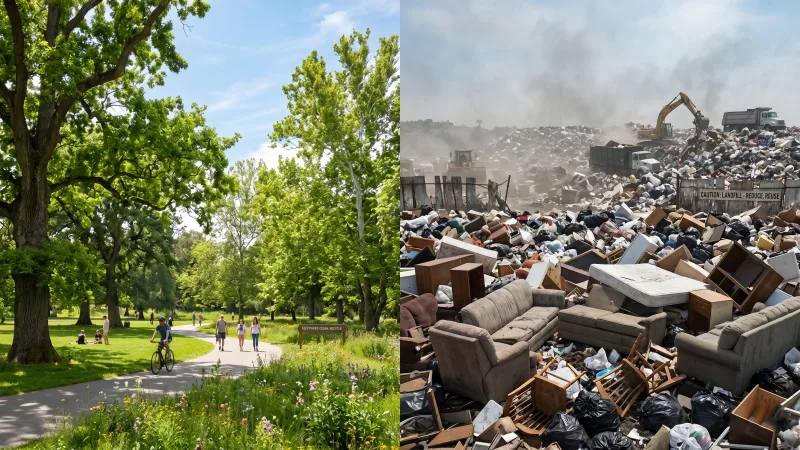
The first thing Seattle taught me about curb furniture is that the weather is the one you're racing, not the other pickers. I found out in Wallingford, on a gray Tuesday, standing over a pale oatmeal sofa that had been genuinely nice at eight in the morning. By the time I came back with a borrowed truck around two, it was holding water like a sponge. You could press a cushion and watch it well up around your thumb. We left it there. Somebody's good couch, killed by four hours of the kind of drizzle this city doesn't even bother to name.
That's the whole lesson, honestly. Everything else is footnotes. But the footnotes are where the good stuff is.
Wet is the entire game
Rain doesn't ruin curb furniture slowly here. It ruins it on a schedule. Foam and upholstery are the first casualties — a sofa or an armchair that's been out overnight in real rain is usually a loss, and worse, it's the kind of loss you can't see from a listing photo. The fabric can look bone dry on top while the underside of the cushion has been wicking moisture off wet pavement for twelve hours. That's how you end up hauling a mildew problem into your apartment. Mold gets into foam and it does not come out. I've tried. Don't.
So two rules. First, move fast. In Seattle a couch that's been out two hours in light mist is probably fine; the same couch at hour sixteen is a science experiment. Check the the map early — morning listings that are still up by lunch are worth a hard look. Second, learn to love cover. The pieces that survive are the ones somebody had the sense to put under an awning, on a covered porch, in an open carport, or tucked beneath the overhang of an apartment building's entry. When I'm scanning a block I'm reading rooflines as much as I'm reading the furniture. A decent dresser under a carport in Ballard on a rainy Thursday is a much safer bet than a nicer one sitting naked at the edge of the sidewalk.
Wood is more forgiving, but check the bottom, always. Water damage shows up on the underside first — swollen edges, particleboard puffing up, finish lifting along the base. The top can look showroom-clean while the feet are already turning to oatmeal.
And bring a tarp. I mean it. A cheap painter's tarp lives in my trunk permanently and it has saved more finds than any other single thing I own. You wrap the piece before it goes in the truck, because the twenty-minute drive home in Seattle is its own weather event, and there's nothing dumber than rescuing a table from the rain and then soaking it on the freeway.
June is when the U-District bursts
If you want to understand Seattle's curb calendar, mark late June. That's when UW lets out and the neighborhoods around campus empty in a single chaotic week. The U-District, Ravenna, the streets down toward Roosevelt — students who furnished a rental in September with whatever they could afford are now flying home, and they are not shipping a IKEA Kallax to Denver. It hits the curb.
The quality is uneven, and I'll be straight with you: a lot of it is tired particleboard that's been through three tenants. But the volume is enormous, and volume is how you find the good stuff. Desks, bookcases, mini-fridges, lamps, the occasional solid-wood dresser somebody's parents bought and nobody wanted to deal with. The move-out surge runs from the last week of June into early July, and the best window is the couple of days right around lease turnover, when leases end on the same date and everything lands at once. Go on foot or by bike if you can. Half the U-District is one-way streets and parking that'll make you want to give up, and the whole point is to cover a lot of blocks quickly.
The tech churn is real, and it's specific
The other engine here is work. Seattle moves people around constantly — a job at Amazon or Microsoft or one of the smaller shops, a relocation, a return-to-office shuffle, a layoff. People arrive fast and leave fast, and a lot of them furnished in a hurry and won't drag it to the next city.
What this means practically: home-office gear shows up on Seattle curbs at a rate I haven't seen anywhere else. Standing desks. Monitor arms. A genuinely good chair now and then — I've seen Aerons put out like they were nothing, because the person leaving town valued their flight more than a used chair. The neighborhoods with a lot of tech renters churn hardest. South Lake Union and the parts of Capitol Hill that fill with people who work down the hill are worth checking after any big office-policy news, because a wave of that always ripples out into the residential blocks a week or two later.
Where I actually walk
Capitol Hill is dense and turns over constantly, which makes it the most reliable neighborhood for sheer frequency, though also the most competitive — you are not the only person watching those blocks. Ballard skews a little more household and family, so you get better dressers, kitchen tables, kids' stuff, and (bonus) more carports and driveways keeping things dry. Fremont is smaller and weirder and I mostly go there on a good feeling rather than a strategy, but the good feeling has paid off more than once.
The thing that ties all of it together is that Seattle just has a strong giving culture. This is the region where Buy Nothing started — the whole gift-economy idea took root here before it went national — and you feel it on the ground. People here don't put a good chair in the dumpster; that reads as almost rude. They set it out with a "free, works great" sign, or they post it, because the assumption is that someone will come get it and use it. That instinct is why the curb is worth working at all. It's also why things move fast, and why a live map beats driving around hoping.
A few things I've learned the hard way
Bring ratchet straps and a friend, not bungee cords and optimism. Cushions get their own trash bag for the ride so road spray doesn't undo your whole plan. If a piece smells like anything at all when you lean in close, walk — smell is the one signal that doesn't lie, and it's usually water. And if you claimed something and can't make it, say so, fast. The person who set it out is doing you a favor, and the next picker is waiting.
That oatmeal sofa in Wallingford still bugs me. Two hours earlier and it would've been mine. In this city that's the whole difference — two hours, and a tarp.